Climbing Safely: The Critical Role of A-Type Ladders and Scissor Lifts in Data Center Cleaning
In a clean, high-density data center environment, cleanliness extends from the floor to the overhead cable racks, and accessing these varying heights for effective cleaning—whether it's dusting server surfaces, cleaning vents, or accessing light fixtures—requires specialized equipment and strict safety protocols. Using inappropriate or unstable access equipment not only puts technicians at risk of injury, but also poses a catastrophic threat to live IT infrastructure.
Climbing Safely: The Critical Role of A-Type Ladders and Scissor Lifts in Data Center Cleaning
By Ashraf Almuhtaseb | Data Center Technical Cleaning Expert | idata.center
In a clean, high-density data center environment, cleanliness extends from the floor to the overhead cable racks, and accessing these varying heights for effective cleaning—whether it's dusting server surfaces, cleaning vents, or accessing light fixtures—requires specialized equipment and strict safety protocols. Using inappropriate or unstable access equipment not only puts technicians at risk of injury, but also poses a catastrophic threat to live IT infrastructure.
In this article, am explaining the strategic and safe use of two essential tools: a Type A safety ladder for low to medium heights and a scissor lift for high areas, emphasizing that people safety and asset protection are inseparable in the data center.
Risks of Improper Ladder Use in the Data Center
The use of a straight ladder or standard extension ladder inside a data center is an unacceptable risk, as narrow aisles, dense cabling, and sensitive equipment create a uniquely hazardous environment:
· Instability and risk of tipping: A straight ladder requires a stable surface to lean against. In a server aisle, the only surfaces available are expensive server racks filled with live equipment. Leaning a ladder against a rack can damage components, displace cables, and, most importantly, cause the ladder to slip or tip over if the rack moves or its feet slip on a raised floor tile.
· Fall hazard: A technician standing on a straight ladder, reaching out to clean, has a high center of gravity. A slip, sudden loss of balance, or ladder slip could result in a serious fall. The impact could injure the technician and cause a chain reaction, damaging multiple server cabinets, cutting important network cables, or triggering an emergency shutdown switch.
· Limited maneuverability: Straight ladders do not provide a platform for tools or require the technician to carry equipment while maintaining balance, which increases the risk.
Type (A) Safety Ladder: A Secure Base for Working at Lower Levels
For tasks performed at a height of approximately 5 or 7 meters (calculated by adding the length of the ladder used to the height of the technician), such as cleaning the front/back of communication cabinets, ventilation openings, or the lower parts of walls, an A-Type ladder (or stepladder) is the correct and safe choice.
· Stability: The self-supporting “A” Type design eliminates the need to lean on the equipment, providing a stable, freestanding base on the data center floor.
· Safe work platform: The top platform provides a secure place to hold a HEPA vacuum hose or cleaning tools, allowing the technician to work with both hands when possible.
· The critical role of the “spotter” or “lookout”: Safety is doubled by one simple procedure: always use a spotter.
The spotter's role is to:
o Secure the ladder: Stand at the base, placing feet on the bottom rungs to prevent any possible movement.
o Ensure stability: Stabilize the ladder, especially when the technician is climbing, descending, or reaching.
o Assist with tools: Help pass and receive equipment, preventing the technician from carrying excess items while climbing.
o Maintain vigilance: Watch for other personnel or equipment in the aisle and alert the technician at the top.
Scissor Lift: Safe Access to High Areas
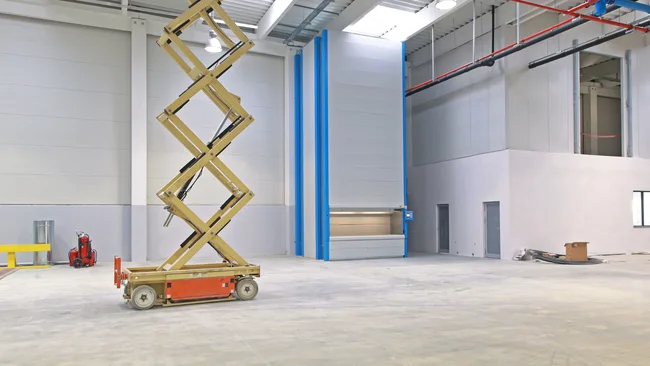
For cleaning tasks above 8 meters, such as high ceilings, overhead cable racks, air ducts, or lighting fixtures, a compact electric scissor lift is the standard solution at this stage.
· Safety and precision: Provides a large, stable, and protected work platform that can be raised and lowered using precise hydraulic controls, allowing the technician to focus on the cleaning task, not on their balance.
· Maneuverability in tight spaces: Narrow aisle models are specifically designed to navigate standard hot/cold aisles in data centers without damaging equipment.
· Trained operator/spotter required: Operating a lift in a data center is a two-person job to ensure maximum safety
· Certified operator: Only employees who are trained and certified on the specific crane model should operate the controls. They are responsible for smooth movement, ensuring the platform is clear of obstacles before moving, and knowing the location of emergency controls.
· Ground spotter (or observer): This important team member walks alongside the lift as it moves. They watch for overhead obstacles (such as fire sprinklers or cables), ensure the lift's path is clear of ground-level hazards (cable loops, tile edges), and maintain communication with the operator at all times.
Important Note: Scissor lifts are used in confined spaces within data centers, especially due to the presence of many overhead systems such as false ceilings, ceiling lighting, and information or electrical cable racks.
It is important to discuss this point with the data center manager to ensure that cleaning tools can reach the maximum point required for cleaning without compromising safety within the data center.
Fall Protection and Safety Harnesses
Whether on an A-Type ladder or in a scissor lift, fall protection is mandatory:
A-Type ladder: Although the design is stable, a safety harness must be worn and secured to a secure anchor point if available, especially for any long or strenuous work.
Inside scissor lifts: This is a definite requirement. Technicians on the platform must wear a full-body safety harness with a safety rope, which must be securely attached to the anchor point specified by the manufacturer inside the lift platform basket. This prevents the technician from falling or climbing barriers in the event of a crane malfunction or sudden movement.
Safety as a basic cleaning protocol is a non-negotiable rule
Data center cleaning is a task that inherently involves working at heights, where dealing with this matter with less than the highest safety standards is an operational risk.
By mandating the use of Type A ladders and operator-guided scissor lifts with mandatory safety harnesses for high levels and the presence of a spotter, facility managers and service providers are doing more than just protecting their employees; they are implementing a comprehensive risk mitigation strategy that protects millions or billions of dollars of IT infrastructure investment from a single preventable accident.
In the critical world of data centers, the right access equipment, used with strict protocols, is not just a tool but a fundamental pillar of operational safety and duty of care.
About the Author
Ashraf Almuhtaseb is a Data Center Technical Cleaning Expert with over 9 years of specialized experience since 2017. He is the only independent professional in the MENA region — and one of very few globally — publishing dedicated, in-depth technical knowledge on data center cleaning standards, contamination control, and ISO 14644 compliance. Visit idata.center for more articles, guides, and resources.
© Ashraf Almuhtaseb | idata.center | All rights reserved
© 2026 Ashraf Almuhtaseb | wurriors.com | All rights reserved