What Manufacturers of Server’s like Dell, HPE, and Lenovo Say About Contaminated Environments!
When a server fails in a contaminated environment, many data center operators assume they are covered under standard warranty and support agreements. They may be wrong. Three of the world's largest enterprise hardware manufacturers — Dell Technologies, Hewlett Packard Enterprise (HPE), and Lenovo, each publish explicit environmental specifications in their official technical documentation. The message across all three is consistent and unambiguous: if contamination levels exceed defined limits and cause equipment damage or failure, the responsibility to correct the environment falls entirely on the customer.
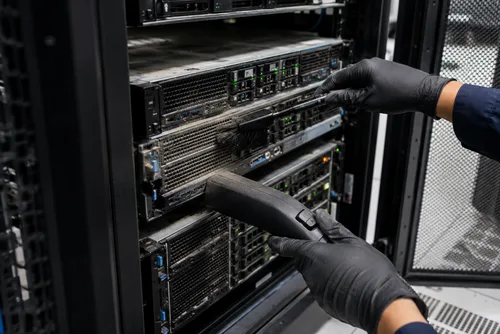
What Dell, HPE, and Lenovo Say About Dirty Data Centers: Why ISO 14644 Is a Manufacturer Requirement
By Ashraf Almuhtaseb | Data Center Technical Cleaning Expert | idata.center
When a server fails in a contaminated environment, many data center operators assume they are covered under standard warranty and support agreements. They may be wrong. Three of the world's largest enterprise hardware manufacturers — Dell Technologies, Hewlett Packard Enterprise (HPE), and Lenovo, each publish explicit environmental specifications in their official technical documentation. The message across all three is consistent and unambiguous: if contamination levels exceed defined limits and cause equipment damage or failure, the responsibility to correct the environment falls entirely on the customer.
This is not marketing language. These are formal technical specifications, published on official manufacturer support portals, sitting alongside processor compatibility tables and power requirements. Understanding what these manufacturers actually require is the first step in protecting your infrastructure investment — and your support entitlements.
*-Dell Technologies: A Universal Standard Across the Entire Product Range
Dell Technologies embeds particulate and gaseous contamination requirements into the technical specifications of every major server and storage product line, from entry-level tower servers to enterprise rack systems. These requirements appear consistently across like the PowerEdge making clear that this is Dell's company-wide position
The Customer Responsibility Clause
E.g., The Dell EMC PowerEdge T440 Technical Specifications states the following under its contamination section:
"If the levels of particulate or gaseous pollution exceed the specified limitations and result in equipment damage or failure, you may need to rectify the environmental conditions. Remediation of environmental conditions is the responsibility of the customer."*
This language is direct and consequential. If contamination causes your hardware to fail, Dell's position is clear: fixing the environment is your problem, not theirs.
Source: Dell EMC PowerEdge T440 Technical Specifications — Particulate and Gaseous Contamination Specifications
https://www.dell.com/support/manuals/en-us/poweredge-t440/pe_t440_techspecs_pub/particulate-and-gaseous-contamination-specifications?guid=guid-c337c292-e2eb-4d1b-b249-5feea0f3abb0&lang=en-us
Air Filtration Requirements
Dell specifies that data center air must meet ISO Class 8 per ISO 14644-1, with a 95% upper confidence limit. Air entering the facility must pass through MERV 11 or MERV 13 rated filtration — grades that capture fine particulate matter well beyond what standard commercial HVAC systems provide.
Conductive Particle Requirements
Dell requires that air within the data center be completely free of conductive dust, zinc whiskers, or any other conductive particles. Critically, this requirement applies to both data center and non-data center environments — meaning any space the equipment occupies must meet this threshold.
Corrosive Dust Requirements
Air must be free of corrosive dust. Where residual dust is present, it must have a deliquescent point below 60% relative humidity, meaning it must not absorb moisture and become conductive or corrosive at normal operating humidity levels.
Gaseous Contamination Limits
For gaseous contamination, Dell specifies corrosion rates consistent with the ANSI/ISA 71.04-2013 standard. The copper coupon corrosion rate must remain below 300 Ångströms per month, placing the environment within Severity Class G1. The silver coupon corrosion rate must remain below 200 Ångströms per month.
Source: Dell PowerEdge T130 Owner's Manual — Environmental Specifications
---
*-Hewlett Packard Enterprise: The Same Position, Across the ProLiant Line
HPE publishes equivalent environmental specifications across its server range, HPE's documentation specifies site environmental considerations that include air quality, particulate contamination, and gaseous corrosion limits consistent with ISO 14644 standards.
HPE's environmental requirements align with the same industry thresholds: ISO Class 8 airborne particulate cleanliness, MERV-rated filtration, freedom from conductive and corrosive particles, and gaseous corrosion limits measured using copper and silver coupons. Operating equipment outside these conditions is operating outside the environment the hardware was designed and rated for.
Source: HPE Site Environmental Considerations
https://support.hpe.com/hpesc/public/docDisplay?docId=sd00006149en_us&page=GUID-B275AE72-C39A-454D-BEE8-35D8862D54BC.html
---
Lenovo: The Most Explicit Language of All Three
Lenovo's environmental specifications for the ThinkSystem SR650 V2 — one of its flagship 2U rack servers — contain the most detailed and legally explicit contamination requirements of all three manufacturers. The documentation is published on Lenovo's official product documentation portal and covers both gaseous and airborne particulate contamination in precise technical terms.
The Particulate Contamination Warning
Lenovo opens its contamination section with a formal caution notice:
"Airborne particulates (including metal flakes or particles) and reactive gases acting alone or in combination with other environmental factors such as humidity or temperature might pose a risk to the device that is described in this document. Risks that are posed by the presence of excessive particulate levels or concentrations of harmful gases include damage that might cause the device to malfunction or cease functioning altogether."
This framing is significant. Lenovo explicitly states that contamination — both particulate and gaseous — can cause a device to malfunction or stop functioning completely. That is a formal acknowledgement, published in product documentation, that environmental cleanliness is directly tied to operational reliability.
The Customer Responsibility Clause
Lenovo then states its position on liability in plain terms:
"If Lenovo determines that the levels of particulates or gases in your environment have caused damage to the device, Lenovo may condition provision of repair or replacement of devices or parts on implementation of appropriate remedial measures to mitigate such environmental contamination. Implementation of such remedial measures is a customer responsibility."
This is among the most direct statements published by any major hardware manufacturer. Lenovo can condition whether it repairs or replaces your device on you first fixing the environment that caused the damage. The warranty or support agreement does not override this.
Reactive Gas Limits
Lenovo specifies that reactive gas levels must be consistent with ANSI/ISA 71.04-1985 Severity Level G1. Copper coupon corrosion must remain below 200 Ångströms per month, and silver coupon corrosion must also remain below 200 Ångströms per month. These thresholds reflect an environment with minimal corrosive gas presence — a standard that deteriorates quickly in poorly maintained facilities.
Airborne Particulate Requirements
The airborne cleanliness level must meet ISO 14644-1 Class 8. For facilities operating without an airside economizer, the data center must maintain continuous room filtration at MERV 8 or better, while all incoming air must pass through MERV 11 or MERV 13 filtration. Any particulate matter present must have a deliquescent point above 60% relative humidity, confirming it will not absorb moisture and become a conductive hazard.
Zinc Whisker Requirements and Testing Methodology
Lenovo requires that the data center be completely free of zinc whiskers — microscopic conductive filaments that grow from electroplated zinc surfaces such as raised floor tiles and older cable management hardware. What makes Lenovo's specification particularly rigorous is that it defines an explicit testing methodology. Surface debris must be collected from ten areas of the data center using 1.5 cm diameter discs of sticky, electrically conductive tape. These samples are then examined under a scanning electron microscope. Only if no zinc whiskers are detected across all ten collection points is the facility considered compliant. This is not a visual inspection — it is laboratory-grade verification.
Source: Lenovo Site, Environmental specifications
https://pubs.lenovo.com/sr650-v2/environment_specifications
What ISO 14644 Class 8 Actually Means
ISO 14644 is the international standard governing cleanroom classification by airborne particle concentration. Class 8 — the minimum standard all three manufacturers require — permits a maximum of 3,520,000 particles per cubic meter at a particle size of 0.5 micrometers or larger.
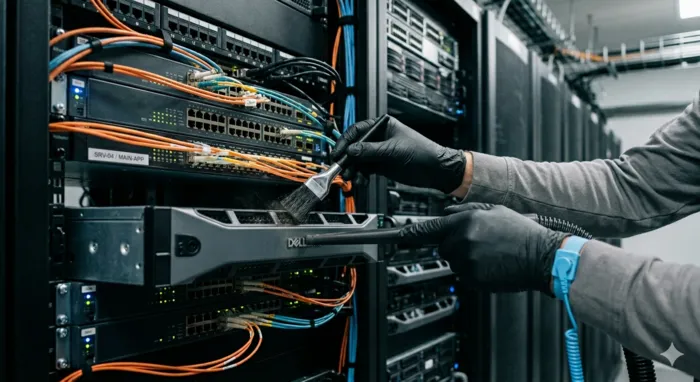
This level of cleanliness is not achieved through normal HVAC operation alone. It requires active management: correct filtration, controlled access, positive pressurization where appropriate, and — critically — regular professional cleaning of equipment surfaces, subfloor voids, cable trays, and overhead infrastructure. The ASHRAE Technical Committee 9.9, in its guidelines on Gaseous and Particulate Contamination for Data Centers, formally endorsed ISO 14644 Class 8 as the reference standard for data center air cleanliness. That recommendation is now embedded directly into the product documentation of every major hardware vendor.
What All Three Manufacturers Require: A Consolidated Overview
Across Dell Technologies, Hewlett Packard Enterprise, and Lenovo, the following requirements appear consistently in official product documentation:
-ISO 14644-1 Class 8 Air Cleanliness** is required by all three manufacturers as the minimum acceptable airborne particulate standard for any environment housing their enterprise equipment.
-MERV 11 or MERV 13 Inlet Filtration** is specified for all air entering the data center, with MERV 8 continuous room filtration required as an ongoing operational standard.
-Freedom from Conductive Dust and Zinc Whiskers** is a non-negotiable requirement across all three vendors. The presence of conductive particles — regardless of their source — represents an unacceptable risk to board-level components and is explicitly cited as a cause of failure.
-Gaseous Corrosion Limits at ANSI/ISA Severity Level G1** are required by all three, verified through copper and silver coupon corrosion testing at defined monthly thresholds.
-Customer Responsibility for Environmental Remediation** is explicitly stated by Dell and Lenovo, with Lenovo going further by making repair and replacement conditional on the customer addressing contamination before service is provided.
All specifications cited in this article are drawn from official technical documentation published on Dell Technologies, Hewlett Packard Enterprise, and Lenovo support and documentation portals, as referenced and linked above.*
About the Author
Ashraf Almuhtaseb is a Data Center Technical Cleaning Expert with over 9 years of specialized experience since 2017. He is the only independent professional in the MENA region — and one of very few globally — publishing dedicated, in-depth technical knowledge on data center cleaning standards, contamination control, and ISO 14644 compliance. Visit idata.center for more articles, guides, and resources.
© Ashraf Almuhtaseb | idata.center | All rights reserved
© 2026 Ashraf Almuhtaseb | wurriors.com | All rights reserved