Do Insects Also Conduct Electricity?
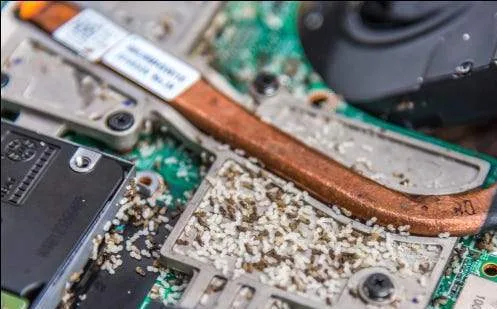
Electronics provide the perfect environment for them to gather around. Whether it's a hefty power supply plugged into an outlet, a game console, an internet router, or even refrigerator motors, the electronic device or appliance can become infested with roaches, feces, and eggs
Do Insects Also Conduct Electricity? The Hidden Risk Inside Your Data Center
By Ashraf Almuhtaseb | Data Center Technical Cleaning Expert | idata.center
Yes. bugs, like cockroaches, ants and bedbugs, are drawn to outlets and electronics because they like spaces that are tight, dark and warm
Electronics provide the perfect environment for them to gather around. Whether it's a hefty power supply plugged into an outlet, a game console, an internet router, or even refrigerator motors, the electronic device or appliance can become infested with roaches, feces, and eggs
When data center managers think about contamination threats, dust, zinc whiskers, and gaseous corrosion are the usual suspects. Insects rarely make the list. Yet scientific research confirms that insects do conduct electricity — and documented cases of insect-related hardware failures in live server environments prove that this is not a theoretical concern. It is a real, measurable, and preventable risk.
^What Science Says: Insects and Electrical Conductivity
The short answer is yes — insects conduct electricity, and peer-reviewed research has confirmed the mechanism in detail.
A study published in the National Institutes of Health (NIH) journal, titled Body Water-Mediated Conductivity Actualizes the Insect-Control Functions of Electric Fields in Houseflies, examined how electricity moves through insect bodies. The research found that the events an insect experiences in an electric field are caused by the conductive nature of the insect body — specifically, the movement of electricity within the body or its release from it. The study demonstrated this by placing adult houseflies (*Musca domestica*) in both static and dynamic electric fields. When dehydrated, the insects showed no electrical response, confirming that it is the water content within the insect body that enables conduction. In living, hydrated insects, electrical current passes through the body freely.
Source: Body Water-Mediated Conductivity Actualizes the Insect-Control Functions of Electric Fields in Houseflies* — National Center for Biotechnology Information (NCBI), PubMed Central
https://pmc.ncbi.nlm.nih.gov/articles/PMC7564027/
It is also worth noting the nuance on insect exoskeletons specifically. Research published by the Entomological Society of America notes that insect cuticle (the outer exoskeleton, made primarily of chitin) acts as a dielectric material — meaning it resists the direct flow of current. However, this applies only to the dry outer shell. The internal body, rich in water and biological fluids, is conductive. A living insect entering an energized circuit does not need a conductive exoskeleton to cause a short circuit — the body fluids will do so when the insect is crushed, disrupted, or dies in contact with live components.
Source: Electric Entomology: How Insects Interact With Electricity in the Environment* — Entomology Today (Entomological Society of America)
https://entomologytoday.org/2025/05/20/electric-entomology-insects-interact-electricity-environment/
^What This Means Inside a Data Center
The scientific findings above describe insect conductivity in controlled research conditions. The data center industry has documented exactly what happens when this conductivity meets live server hardware.
Capitoline Data Centre Training, a recognized provider of certified data center cleaning education, published an article drawing on real-world case studies from data center consultancy work. Their documentation includes a photograph of a failed power supply unit from an IBM server, where the failure was directly attributed to a cockroach short-circuiting the printed circuit board (PCB). The case is cited from IBM's own 2005 publication, Why do Power Supplies Fail, and What Can Be Done About It?
The article states plainly: "Insects also conduct electricity." It goes on to list insect ingress as one of the primary contamination sources in data centers alongside external dust, internal dust, pollen, and zinc whiskers — all of which are already well-established concerns in the industry.
Source: How Insects, Dirt and Dust Cause Data Centre Failures* — Data Centre Training by Capitoline
https://www.capitolinetraining.com/how-insects-dirt-and-dust-cause-data-centre-failures/
^How Insects Enter Data Centers
The common assumption that data centers are sealed, sterile environments is often incorrect. A detailed analysis published by PestClinic.sg — a pest management provider serving data center operators — outlines the entry routes insects routinely exploit. Service ducts, utility line penetrations, cracks in walls, and even deliveries of new equipment can all introduce insects into the facility. Once inside, insects are drawn to the warmth generated by operating servers and power units, sheltering behind rack systems, in subfloor voids, and within cable trays — precisely the areas most difficult to inspect and most likely to house live electrical components.
Source: Why Pests in Data Centres Are a Hidden Threat and What To Do* — PestClinic
https://www.pestclinic.com.sg/why-pests-in-data-centres-are-a-hidden-threat-what-to-do/
In regions such as Saudi Arabia and the wider Gulf, the risk is compounded by fine desert particulate matter that infiltrates facilities through the same routes insects use — and which can carry insect matter, shed exoskeletons, and organic debris alongside mineral dust.
^The Failure Mechanism: How an Insect Causes a Short Circuit
Understanding the exact failure mechanism helps clarify why this risk is taken seriously by data center professionals.
When a living insect enters an energized space such as the interior of a power supply unit, across bus bar contacts, or between PCB traces its body fluids act as a conductive bridge between two points at different electrical potentials. This creates an unintended current path: a short circuit. The energy discharged through this path can be instantaneous and severe, destroying the component, triggering a protection circuit, or in the worst cases starting a localized electrical fire.
When an insect dies on a PCB or within a component and its body dries out, the risk does not disappear. Dried insect matter including body fragments, shed skins, egg casings, and faecal deposits is organic debris that can trap moisture over time, become mildly conductive, and contribute to corrosion of contact surfaces and board traces.
^The Cost of Ignoring the Risk
The financial consequences of insect-related data center failures are significant. According to survey data cited by Capitoline Training, data center outages cost approximately $9,000 per minute, with an average outage event costing $740,000. Beyond the direct financial impact, there are reputational consequences and potential contractual liability for facilities failing to deliver agreed service levels.
A single cockroach entering a power supply unit as documented by IBM can produce an outage at a cost orders of magnitude higher than a year's professional cleaning and pest prevention program.
^What is the Recommendation in the Data Center Industry
Across data center hygiene guidance, the recommendations for insect prevention align closely with those for dust and particle control, because the entry routes are identical.
Filtering all incoming air through MERV-rated filtration prevents the ingress of both particulate matter and small insects carried in on airflows. Maintaining positive air pressure within the technical space means that any gap or penetration in the building envelope creates outward airflow rather than inward preventing insects from entering through small openings. Sealing all cable penetrations, floor tile cutouts, and wall services eliminates the gaps through which insects commonly enter. Regular professional cleaning of subfloor voids, overhead cable trays, and rack interiors removes not only dust but the organic matter that attracts insects in the first place.
These are not separate disciplines. Dust control and insect prevention are the same program, executed by the same specialist cleaning team, following the same ISO 14644 standards that major hardware manufacturers require.
Sources cited in this article are drawn from scientific publications indexed by the research published in the journal National Institutes of Health (NIH), Entomological Society of America, industry documentation from IBM, Capitoline Data Centre Training and PestClinic, as referenced and linked above.
About the Author
Ashraf Almuhtaseb is a Data Center Technical Cleaning Expert with over 9 years of specialized experience since 2017. He is the only independent professional in the MENA region — and one of very few globally — publishing dedicated, in-depth technical knowledge on data center cleaning standards, contamination control, and ISO 14644 compliance. Visit idata.center for more articles, guides, and resources.
© Ashraf Almuhtaseb | idata.center | All rights reserved
© 2026 Ashraf Almuhtaseb | wurriors.com | All rights reserved