Drilling Inside Data Centers: Dust Control and Best Practices
Data centers are among the most sensitive operational environments in the world. They house mission-critical infrastructure — servers, storage systems, networking equipment, and power distribution units — that must function continuously, reliably, and without interruption. Even a minor environmental disturbance can cascade into hardware degradation, increased failure rates, or costly unplanned downtime.
Drilling Inside Data Centers: Dust Control and Best Practices
By Ashraf Almuhtaseb | Data Center Technical Cleaning Expert | idata.center
Drilling and Construction Work Inside Data Centers: Dust Control, Risk Management, and Best Practices
Data centers are among the most sensitive operational environments in the world. They house mission-critical infrastructure — servers, storage systems, networking equipment, and power distribution units — that must function continuously, reliably, and without interruption. Even a minor environmental disturbance can cascade into hardware degradation, increased failure rates, or costly unplanned downtime.
Yet despite their sensitivity, data centers are not static environments. Facilities expand. Racks get relocated. New power circuits are installed. Cable pathways are modified. Fire suppression systems are upgraded. In all of these scenarios, drilling into walls, floors, ceilings, and structural elements is often unavoidable.
Drilling inside a live or partially live data center is one of the highest-risk maintenance activities a facility team can authorize. The dust, debris, and fine particulate matter generated during drilling can travel far beyond the immediate work area, infiltrating server intakes, coating circuit boards, clogging cooling vents, and settling into raised floor plenums. The consequences are rarely immediate — which is precisely what makes them dangerous. Contamination accumulates silently and manifests weeks or months later as unexplained hardware failures, thermal shutdowns, or accelerated component degradation.
This article is written for data center managers and facility engineers who need to plan, authorize, or oversee drilling and light construction work inside operational facilities. It covers the risks in detail, the tools and methods available to control those risks, and the scheduling practices that protect both the infrastructure and the people working within it.
1- Understanding the Risk — What Drilling Does to a Data Center Environment
1.1 The Nature of Drilling Dust
When a drill bit penetrates concrete, drywall, steel, or composite material, it generates a spectrum of particulate matter. This is not ordinary household dust. Depending on the substrate being drilled, the particles generated include:
Concrete dust — fine calcium silicate and calcium carbonate particles, often in the sub-10 micron range
Drywall dust — gypsum particles that are extremely fine and highly mobile in air
Steel shavings and metal filings — conductive particles that are particularly dangerous around electronic equipment
Composite material particles — a mix of synthetic resins, fibers, and mineral compounds from modern construction materials
Paint and coating fragments — which may contain older chemical compounds in legacy facilities
The critical factor is particle size. Particles below 10 microns remain airborne for extended periods — sometimes hours — and travel with air currents throughout the data center. Particles below 2.5 microns are almost impossible to control without active filtration and containment, and they penetrate deep into server chassis and equipment enclosures through the smallest gaps.
In a data center environment, airflow is engineered to be highly efficient — hot aisle/cold aisle configurations, precision air conditioning units, and in-row cooling all create strong, directed airflows. These same airflows that protect your servers from heat become distribution highways for drilling dust.
1.2 How Dust Damages Data Center Equipment
Understanding why dust is dangerous helps facility engineers make better decisions about when and how to authorize drilling work. The damage mechanisms are multiple and compound over time:
Thermal Insulation Effect Dust accumulating on server components, heat sinks, and circuit boards acts as thermal insulation. Even a thin layer of dust — invisible to casual inspection — increases the thermal resistance of components. This means heat generated by processors, memory modules, and power supplies dissipates less efficiently. The result is elevated operating temperatures, which accelerate component aging and increase failure probability. Studies within the electronics industry consistently show that operating temperatures 10°C above design specifications can reduce component lifespan by 50% or more.
Electrical Conductivity and Short Circuits Metal particles generated during drilling — particularly when working near cable trays, conduits, or steel structural elements — are electrically conductive. When these particles settle across PCB traces, connector pins, or within PSU modules, they create unintended electrical pathways. The result can be intermittent faults that are extremely difficult to diagnose, or in severe cases, direct short circuits.
Abrasive Damage to Moving Components Data center environments still contain moving components — cooling fans, drive mechanisms in legacy systems, tape libraries, and precision cooling units. Fine abrasive particles from drilling — silica from concrete, gypsum crystals from drywall — accelerate wear on fan bearings and rotating assemblies. Fan bearing failure is one of the most common hardware issues in dusty data center environments and often goes unattributed to its actual cause.
Clogged Air Filters and Reduced Airflow Cooling systems in data centers rely on air filters to maintain clean airflow. A single uncontrolled drilling session can load these filters with particulate matter that would normally accumulate over months. Clogged filters restrict airflow, reducing cooling efficiency and potentially triggering thermal protection responses in equipment — including automatic throttling or shutdown.
Contamination of Raised Floor Plenums In data centers with raised floor systems, the plenum beneath the tiles is a critical component of the cooling infrastructure. Cold air is delivered through the plenum to perforated tiles and into the cold aisles. Drilling dust that falls through tile gaps or cable cutouts settles in the plenum, where it is then re-entrained into the airflow and continuously recirculated through the facility. A contaminated plenum is one of the hardest cleaning challenges in data center maintenance and one of the most persistent sources of ongoing equipment contamination.
1.3 The Compounding Factor: Data Center Airflow Dynamics
One of the most important things a data center manager must understand about drilling dust is that the facility's own HVAC and cooling systems will actively distribute it. The precision cooling infrastructure designed to protect your equipment will — without proper containment in place — become the mechanism by which drilling contamination spreads to every corner of the data center.
Return air paths, underfloor plenums, overhead cable trays, and cold aisle containment systems all create air movement patterns that carry fine particles across the entire floor space within minutes. This is not a theoretical risk. It is the consistent finding of facility teams that have dealt with post-construction contamination events.
2- Using a Dust Extractor — The First Line of Defense
2.1 Why a Dust Extractor is Non-Negotiable
A dust extractor — also referred to as a vacuum shroud system or on-tool extraction unit — is the single most important piece of equipment for any drilling work inside a data center. It is not optional. In any professionally managed data center, drilling without an active dust extraction system attached directly to the drill should be treated as a procedural violation.
The principle is straightforward: capture the dust at the point of generation before it becomes airborne. Once particles are airborne inside a data center, control becomes exponentially more difficult and expensive. Containment and HEPA filtration become reactive measures. Dust extraction is the proactive measure that prevents the problem from occurring in the first place.
2.2 Types of Dust Extractors Suitable for Data Center Work
Not all dust extractors are appropriate for data center environments. The selection must be based on filtration efficiency, air volume capacity, and the ability to operate quietly enough not to disrupt adjacent operations.
HEPA-Filtered Dust Extractors (M or H Class)
The classification of dust extractors follows European standards (EN 60335-2-69) and is adopted broadly across professional industries:
L Class (Low hazard) — filters particles down to 1 micron with 99% efficiency. Not sufficient for data center environments.
M Class (Medium hazard) — filters particles down to 0.3 microns with 99.9% efficiency. Acceptable for most data center drilling work involving concrete, drywall, and composite materials.
H Class (High hazard) — filters particles down to 0.3 microns with 99.995% efficiency (equivalent to HEPA H14). Required when drilling near extremely sensitive equipment or when working with materials that may contain hazardous compounds.
For data center applications, M Class minimum, H Class preferred. The marginal cost difference between M and H Class units is insignificant compared to the cost of equipment damage from inadequate filtration.
Integrated Tool-Mounted Shroud Systems Many professional hammer drills and rotary drills accept shroud attachments that create a sealed capture zone around the drill bit at the point of contact with the surface. These shrouds connect directly to the extraction hose, ensuring that virtually all generated dust is captured before it can enter the ambient environment. For data center work, shroud-mounted extraction is strongly preferred over handheld hose management.
2.3 Operational Protocol for Dust Extractor Use
Having the right equipment is only part of the solution. The operational protocol governing its use determines its actual effectiveness:
Pre-Work Inspection Before beginning any drilling, inspect the dust extractor:
Confirm the filter is clean and within its service life
Check that all hose connections are secure and airtight
Verify the collection container is empty and properly sealed
Test suction at the tool attachment point before beginning work
Continuous Operation The dust extractor must run continuously throughout drilling — not intermittently. Switch it on before the drill contacts the surface and keep it running for a minimum of 30 seconds after drilling stops, to capture any residual dust settling from the immediate work zone.
Filter Management In data center environments, filter loading happens faster than in construction environments because the requirement is zero escape, not just minimal escape. Plan to inspect and potentially replace filters after every major drilling session. A partially loaded filter operates at reduced efficiency. Never shake out or clean filters in the data center space — remove the entire unit, change filters in a designated clean area, and return the unit to service.
Post-Work Verification After drilling is complete, use a bright flashlight (or ideally a laser particle counter) to check for visible dust suspension in the immediate work area. Any visible dust indicates that the extraction was incomplete and additional cleaning is required before containment is removed.
3- Temporary Plastic Curtains — Containing the Work Zone
3.1 The Principle of Physical Containment
Even with best-in-class dust extraction at the tool level, drilling generates some degree of ambient dust — from surface disturbance, material falling away from the drill point, and air displacement by the drilling action itself. Physical containment of the work zone is the second layer of defense, designed to prevent any escaped particles from migrating into the broader data center environment.
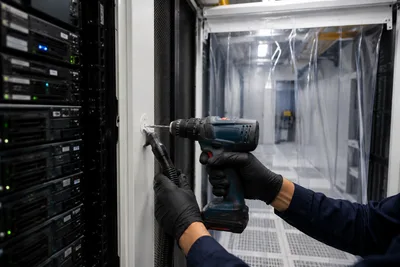
Temporary plastic curtains — also called poly sheeting, containment barriers, or dust curtains create a physical envelope around the drilling area. They are a standard practice in cleanroom construction and modification, pharmaceutical facility maintenance, and hospital infection control. Data centers warrant the same level of containment rigor.
3.2 Selecting the Right Containment Material
Not all plastic sheeting is equal, and the selection matters for data center applications:
Polyethylene Sheeting (6 mil minimum) Standard 6-mil (0.15mm) polyethylene sheeting is the minimum acceptable thickness for data center containment. Thinner sheeting tears easily, creating gaps that compromise the containment boundary. For longer-duration projects or where the sheeting must be repositioned, 10-mil sheeting provides better durability.
Anti-Static Poly Sheeting This is the critical distinction for data center environments. Standard polyethylene sheeting generates electrostatic charge when disturbed by air movement or physical contact. In a data center, this static charge can attract and accumulate fine conductive particles on the surface of the sheeting, and it creates a risk of electrostatic discharge (ESD) events near sensitive equipment. Anti-static poly sheeting dissipates charge and is the correct specification for any containment work in a data center. It is available in standard colors and in most standard widths.
Zipper Access Panels For work zones that technicians need to enter and exit during the drilling operation, pre-fabricated zipper panels installed in the poly sheeting provide controlled access without requiring the entire containment barrier to be disturbed. This is important because opening and closing large sections of sheeting creates air movement that can carry particles across the containment boundary.
3.3 Designing the Containment Zone
The containment zone must be designed before work begins, not improvised during the job. A well-designed containment zone accounts for:
Zone Footprint The containment boundary should extend a minimum of 2 meters beyond the drilling point in all directions. This accounts for the arc of material ejected by the drilling action and the immediate air displacement zone. For drilling into raised floor supports, cable tray mounts, or overhead structural elements, the zone should extend to the floor below the work point to capture falling debris.
Ceiling Coverage In data centers with open overhead cable trays or perforated ceiling panels, dust can migrate upward into the overhead zone and be recirculated by HVAC systems. The containment zone should include a ceiling layer — sheeting draped or taped across the overhead area — whenever the work is in proximity to return air paths or open cable management systems.
Underfloor Access Points If the drilling area is near raised floor tiles, those tiles should either be removed and stored outside the containment zone (to prevent dust infiltration into the plenum) or sealed around their edges with tape to prevent dust from entering the plenum gap. After work is complete, the tiles and the plenum area directly beneath the work zone should be inspected and cleaned before the tiles are replaced.
HVAC and Cooling Unit Isolation Identify all precision cooling units, in-row coolers, and HVAC return air intakes within 5 meters of the work zone. These units should be temporarily isolated — either shut down for the duration of the work or covered with filter media — to prevent them from drawing drilling dust into the cooling infrastructure. Coordinate with the data center operations team to manage cooling redundancy during this isolation period.
Sealing the Perimeter The bottom edge of the containment sheeting must be sealed to the floor to prevent dust from migrating beneath the barrier. Weighted edges tape sealed to the floor tile or a folded and taped hem at the base are all acceptable methods. Gaps at floor level are the most common failure point in containment systems and the most likely path for dust to escape.
3.5 Containment Removal Protocol
Removing the containment system at the end of work is as important as installing it correctly. Incorrect removal can release accumulated dust into the data center environment:
Before removing any sheeting, use a HEPA vacuum to clean all surfaces of the containment barrier, working from the top down
Fold the sheeting inward toward the center of the containment zone (never pull it outward) to trap accumulated dust inside the fold
Bag the sheeting immediately in sealed waste bags before removing it from the work zone
Clean the floor and surrounding area within the former containment zone with a HEPA vacuum before declaring the work complete
4- The Pre-Work Briefing
Before any drilling begins, a structured pre-work briefing should be conducted with all parties involved the drilling crew, the data center operations team representative, and the facilities manager. This briefing should cover:
Risk Acknowledgment Every person present should understand that drilling inside a data center is a high-risk activity and that the containment procedures are not optional. The briefing is the appropriate moment to reinforce that no shortcuts will be taken and that work will stop immediately if containment integrity is compromised.
Emergency Procedures Define clearly what constitutes a stop-work condition: visible dust escaping the containment zone, equipment alarms in adjacent racks, containment sheeting failure, extraction unit malfunction. Establish who has the authority to call a stop-work and what the response procedure is.
Communication Protocol Establish a communication channel between the drilling crew inside the containment zone and the operations team monitoring the data center floor. In a noisy drilling environment, verbal communication is not reliable. A simple two-radio system or predetermined hand signals for the access zipper are sufficient.
Work Scope Confirmation Confirm the exact scope of the drilling work — number of holes, diameter, depth, substrate — and confirm that all required permissions and change management approvals are in place. Changes to scope during the work session should require a new approval cycle, not on-the-spot authorization.
4.1 Coordinating with Change Management
In enterprise data centers, drilling work should always pass through the formal change management process — not bypassed as a maintenance task. The change record should document:
The location and nature of the drilling work
The containment measures in place
The dust extraction equipment being used
The operational window selected and the justification
The access restrictions being enforced
The post-work verification and cleaning steps planned
The person responsible for signing off work completion
This documentation serves two purposes: it forces the systematic application of best practices, and it creates an audit trail that is invaluable if equipment issues arise in the weeks following the drilling work. Without this record, attributing hardware problems to drilling contamination — and therefore identifying and remedying the root cause — is nearly impossible.
5- Post-Drilling Procedures — Verification and Cleaning
5.1 Why Post-Drilling Cleaning is a Separate Discipline
The drilling activity itself, managed with the measures described above, addresses the primary risk. But post-drilling cleaning is a distinct phase with its own protocols, and it is where many facilities fall short. The assumption that removing the containment zone and visually inspecting the area is sufficient is incorrect. Invisible contamination — sub-micron particles that settled on surfaces, infiltrated equipment chassis gaps, or entered the underfloor plenum — requires systematic verification and removal.
5.2 Immediate Post-Drilling Verification
Immediately after drilling is complete and before any containment is removed:
Particle Count Verification If your facility has a handheld particle counter (a basic requirement for any data center with formal cleanliness standards), take particle count readings inside the containment zone and immediately outside it. Readings inside the zone should be elevated — this is expected. Readings outside the zone should be at or near baseline levels. Any elevation outside the zone indicates a containment breach that must be investigated and addressed before proceeding.
Visual Inspection with Directed Light Use a high-intensity flashlight or laser line projector to illuminate the air column inside the containment zone. Visible dust suspended in the beam confirms that particles are still airborne. The zone should not be disturbed or entered until this airborne dust has settled and been captured by the extraction unit. Allow the extraction unit to run for a minimum of 15 minutes after drilling stops before entering the zone for cleanup.
Equipment Status Check The operations team should check the status of all equipment in racks adjacent to the work zone. Review any alerts, temperature readings, or fan speed changes that occurred during the drilling period. These are early indicators of dust infiltration and should be investigated immediately rather than monitored passively.
5.3 Structured Cleaning Sequence
Post-drilling cleaning inside the former containment zone should follow a top-down sequence:
Overhead Surfaces First Clean ceiling panels, overhead cable trays, and any surfaces above head height before working at lower levels. This prevents dust dislodged from overhead surfaces from re-contaminating already-cleaned lower surfaces.
Vertical Surfaces Clean walls, rack faces adjacent to the work zone, and any equipment enclosure surfaces. Use a HEPA vacuum with a soft brush attachment for surfaces adjacent to equipment. Avoid dry wiping, which resuspends particles.
Horizontal Surfaces Floor tiles, cable management horizontal trays, and top-of-rack surfaces should be HEPA vacuumed and then wiped with lint-free cloth. In data center cleaning, dry vacuuming followed by damp wiping (using appropriate cleaning fluids) is the standard protocol.
Underfloor Inspection Lift floor tiles in the work zone and inspect the plenum. Any visible dust or debris in the plenum must be removed using appropriate sub-floor HEPA vacuuming equipment before tiles are replaced. This step is frequently skipped and is one of the primary reasons that data center contamination events recur after construction work.
5.4 Verification Cleanliness Standard
The post-work cleanliness standard should be defined before work begins, not assessed subjectively after completion. ISO 14644-1 defines cleanroom classifications by particle concentration; while most data centers do not operate as formal cleanrooms, using these standards as a reference gives facility teams a defined and defensible cleanliness target.
For data center environments, a common practical standard is that post-work particle counts should return to pre-work baseline levels within 2 - 4 hours of work completion. If this target is not met, additional cleaning and investigation is required before the operational window is closed and normal access resumes.
6- Building a Formal Drilling Policy for Your Data Center
6.1 Why a Written Policy Matters
Individual best practices, however well understood by the facility manager, are only effective when they are consistently applied. In organizations with multiple engineers, rotating shifts, and contractors, the gap between what the policy intends and what actually happens on the floor is bridged only by documented, enforced standards.
A formal drilling and construction activity policy for your data center should be a standing document within your facility management system, referenced in every change management request involving physical work, and reviewed annually.
6.2 Core Elements of a Data Center Drilling Policy
Scope of Application Define what activities the policy covers: any drilling, coring, cutting activity that penetrates a surface inside the data center floor boundary. Include work on raised floor supports, overhead cable tray mounting, fire suppression pipe supports, and structural elements within the data center envelope.
Authorization Requirements Specify who must authorize drilling work: typically the data center manager plus a facilities representative. Define the minimum notice period required for scheduling (recommended: 72 hours minimum for planned work, emergency authorization path for unplanned critical work).
Mandatory Equipment List
M Class or H Class HEPA dust extractor with appropriate tool attachment
Anti-static poly containment sheeting (6 mm minimum)
Containment poles or equivalent structural support
tape for surface attachment
HEPA vacuum for post-work cleanup
Lint-free cleaning cloths
Personal protective equipment (respiratory protection, eye protection, gloves)
Mandatory Procedures Reference the containment setup, extraction protocol, operational window requirements, pre-work briefing, and post-work verification steps. These should be described in sufficient detail that an engineer following the policy for the first time could execute it correctly.
Post-Work Sign-Off Define the sign-off process: who inspects the work, what standards are applied, and what documentation is completed before the work is officially closed.
6.3 Contractor Management
Many drilling and construction activities inside data centers are performed by contractors, electrical subcontractors, mechanical engineers, structured cabling teams, or specialist fit-out contractors. These parties bring their own working methods and may not be familiar with data center environmental standards.
Your drilling policy must apply equally to contractors, with no exceptions. Include the following in contractor management for drilling work:
Pre-qualification: confirm that the contractor has experience with dust-controlled drilling and has appropriate extraction equipment. Ask to see their equipment before work begins.
Pre-work briefing: include contractors in the mandatory briefing and ensure they understand that data center protocols supersede their standard working practices
On-site supervision: a data center staff member should be present during the drilling activity at all times. Contractors should never be left unsupervised inside the data center during active drilling work
Liability clause: include in the contractor agreement a clause specifying liability for equipment damage caused by failure to follow the data center's environmental protection protocols
About the Author
Ashraf Almuhtaseb is a Data Center Technical Cleaning Expert with over 8 years of specialized experience since 2017. He is the only independent professional in the MENA region — and one of very few globally — publishing dedicated, in-depth technical knowledge on data center cleaning standards, contamination control, and ISO 14644 compliance. Visit idata.center for more articles, guides, and resources.
© Ashraf Almuhtaseb | idata.center | All rights reserved
© 2026 Ashraf Almuhtaseb | wurriors.com | All rights reserved