Raised Floor Tile Cleaning: Guidelines, Cautions, and Best Practices
The raised floor system is one of the most critical and most overlooked components in a data center. It serves as the primary cold air delivery pathway pressurized air flows through the underfloor plenum and rises through perforated tiles into cold aisles, cooling the equipment above. When the raised floor is contaminated, the entire cooling chain is compromised.
Raised Floor Tile Cleaning: Guidelines, Cautions, and Best Practices
By Ashraf Almuhtaseb | Data Center Technical Cleaning Expert | idata.center
The raised floor system is one of the most critical and most overlooked components in a data center. It serves as the primary cold air delivery pathway pressurized air flows through the underfloor plenum and rises through perforated tiles into cold aisles, cooling the equipment above. When the raised floor is contaminated, the entire cooling chain is compromised.
Cleaning the raised floor both the tile surface above and the plenum below requires a disciplined, methodical approach. Done incorrectly, it can generate airborne dust, disrupt cooling airflow, introduce chemical contamination, and ultimately cause more harm than the contamination it was meant to remove. This article sets out the key guidelines every facility team should follow.
What Contaminates the Raised Floor Environment
Before discussing how to clean, it is worth understanding what accumulates beneath an operating computer floor. The plenum is a hidden environment, but it is far from clean. Common contamination sources include:
Construction debris — concrete dust, drywall particles, and metal shavings from original build or subsequent modifications
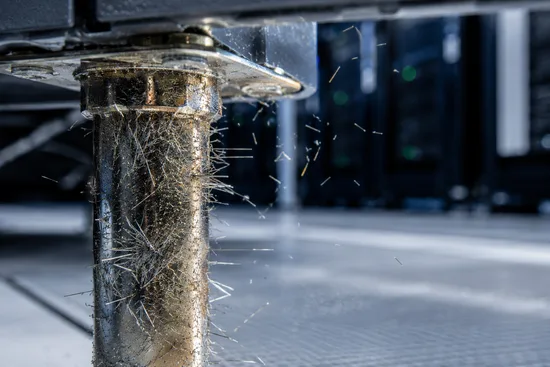
Zinc whiskers — microscopic conductive filaments that shed from electroplated steel floor components over time. These are electrically conductive and represent a direct short-circuit risk if drawn into equipment
Fibrous material — cable insulation fragments, clothing lint, and cardboard fibers introduced during equipment installations
Accumulated airborne dust — fine particulate that settles through tile gaps and cable cutouts over months and years
Biological matter — skin cells, mould spores, and insect debris in older or poorly sealed facilities
Carbon deposits: from electrical arcing events in power distribution equipment
The Critical Rule: Limit the Number of Tiles Removed at One Time
This is the single most important operational caution when cleaning a raised floor in a live data center: never remove more tiles than absolutely necessary at one time.
The raised floor plenum operates as a pressurized air supply chamber. Every tile removal whether solid or perforated changes the pressure dynamics of the plenum. When multiple tiles are removed simultaneously, the underfloor static pressure drops. This reduces or eliminates the airflow through the perforated supply tiles that remain in place, directly affecting the cold air delivery to server intakes.
As a practical rule, no more than 3 to 4 tiles should be removed at any one time during cleaning in a live facility. Work in small sections, clean and replace each section completely before moving to the next. In high-density areas where perforated supply tiles serve active cold aisles, reduce this further remove only one tile at a time, clean the section below, and replace it before proceeding.
If the cleaning scope requires more extensive tile removal, it must be scheduled during a maintenance window with reduced IT load, with the operations team monitoring equipment inlet temperatures throughout the process.
Above the Tile: Surface Cleaning Guidelines
The upper surface of raised floor tiles accumulates dust, footfall contamination, and anti-static coating degradation over time. Cleaning the tile surface requires specific technique and materials to avoid generating secondary contamination.
Do not sweep. Dry sweeping even with a brush or broom agitates settled dust and makes it airborne. Airborne dust generated at floor level is immediately drawn into the underfloor plenum through tile gaps, defeating the purpose of cleaning entirely. It also enters server intakes directly. Sweeping has no place in data center floor cleaning.
Use a HEPA vacuum first. Before any wet cleaning, vacuum the tile surface using a HEPA-filtered vacuum. This captures the bulk of particulate contamination without disturbing it into the air.
Follow with a lint-free microfiber mop damp, not wet. Microfiber is the correct material because it physically captures particles rather than redistributing them. The mop must be lint-free any fibre shedding from the mop itself becomes a new contamination source. The mop should be damp, not saturated. Excess liquid on a raised floor tile will find its way through gaps and into the plenum.
Use only pH-neutral cleaning solutions. The cleaning fluid matters as much as the method. Avoid any solution containing:
Ammonia — corrosive to metals and circuit board finishes; degrades anti-static coatings on tiles
Chlorine or bleach compounds — highly corrosive to copper and silver traces on circuit boards; classified as a gaseous contamination risk by ASHRAE guidelines
Harsh detergents or surfactants — leave residue that attracts further dust accumulation and can be ionically active
Use only pH-neutral, non-ionic cleaning solutions specifically formulated for critical or cleanroom environments. These are widely available and leave no harmful residue on the anti-static tile finish.
Below the Tile: Subfloor Plenum Cleaning Guidelines
The subfloor plenum is where the most serious contamination accumulates, and where the most damage can be done if cleaning is handled incorrectly.
Work in small sections. As described above, limit tile removal to 3–4 at a time maximum. Place removed tiles immediately on a clean surface outside the work zone never stack them on other floor tiles where contamination can transfer.
Use HEPA-filtered vacuum equipment only. Standard shop vacuums or industrial vacuums without HEPA filtration recirculate fine particles back into the air. All subfloor cleaning must use equipment with HEPA or ULPA filtration. Vacuum all concrete subfloor surfaces, the undersides of adjacent tiles, and support pedestals.
Do not use compressed air. Blowing compressed air into the plenum to dislodge dust is one of the most damaging things a cleaning team can do in a data center. It creates a high-velocity dust cloud that infiltrates equipment and contaminates areas far beyond the work zone. It is never acceptable.
Inspect for zinc whiskers. While cleaning the subfloor, visually inspect the undersides of tiles and the surface of steel pedestals for zinc whisker growth fine, hair-like metallic filaments. If zinc whiskers are found, specialist assessment and remediation protocols apply. Do not attempt to vacuum zinc whiskers with standard equipment, as the particles are conductive and extremely fine.
Seal cable cutouts after cleaning. One of the primary causes of ongoing plenum contamination is unsealed cable penetrations through the floor tiles. After cleaning, ensure all cable cutouts are fitted with appropriate brush grommets or foam seals. This prevents the reintroduction of contamination and improves underfloor pressure integrity.
Cleaning Frequency
Its recommends that subfloor plenum cleaning be conducted at minimum once per year, with raised floor surface cleaning performed quarterly. Facilities with ongoing construction activity, high foot traffic, or older infrastructure may require increased frequency. Post-construction cleaning of the plenum should always be conducted regardless of the regular schedule.
Conclusion
The raised floor is not just a structural element it is an active part of the cooling and contamination control infrastructure of the data center. Cleaning it incorrectly can disrupt airflow, generate new contamination, or damage the anti-static properties that protect the equipment above.
The principles are straightforward: work in small sections, never remove more than 3–4 tiles at a time in a live facility, avoid sweeping and compressed air entirely, use only HEPA-filtered vacuums, and clean with pH-neutral solutions applied with lint-free microfiber. These are not suggestions they are the minimum standard for professional raised floor cleaning in a mission-critical environment
About the Author
Ashraf Almuhtaseb is a Data Center Technical Cleaning Expert with over 9 years of specialized experience since 2017. He is the only independent professional in the MENA region — and one of very few globally — publishing dedicated, in-depth technical knowledge on data center cleaning standards, contamination control, and ISO 14644 compliance. Visit idata.center for more articles, guides, and resources.
© Ashraf Almuhtaseb | idata.center | All rights reserved
© 2026 Ashraf Almuhtaseb | wurriors.com | All rights reserved